
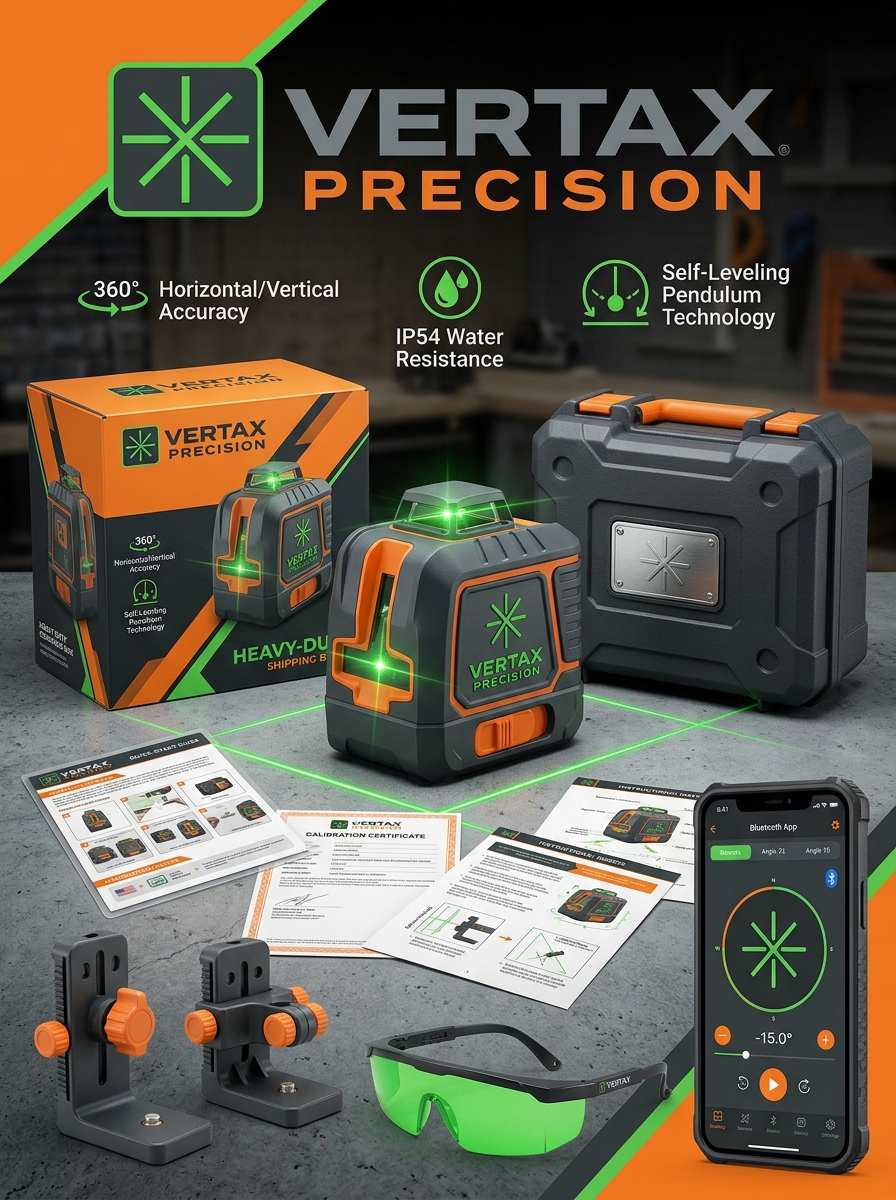
Precision instruments like self-leveling laser levels require more than just a sturdy box; they demand a packaging strategy that mirrors their internal technological sophistication. For manufacturers and designers, creating the perfect housing involves a delicate balance between rugged durability and modern aesthetic appeal.
Effective packaging serves as the primary touchpoint for professionals, communicating accuracy and reliability before the tool is even powered on. By integrating essential design concepts-such as ergonomic unboxing experiences and high-impact visual hierarchies-brands can significantly elevate their market presence. This exploration delves into the core principles of structural integrity and aesthetic refinement, illustrating how thoughtful design enhances the perceived value of high-end optical tools while ensuring maximum protection during transit.
Strategic Visual Hierarchy for Precision Tool Branding
Establishing a strategic visual hierarchy is essential for branding high-performance self-leveling laser levels. In a market defined by accuracy, the visual design must communicate reliability and technical sophistication. By prioritizing key information-such as automatic calibration alerts and diode brightness specs-brands can ensure professionals quickly identify the tool's superior precision.
Effective branding for these instruments utilizes specific design elements to guide the user's focus:
- High-Contrast Typography: Ensures readability of leveling metrics in diverse job site lighting.
- Functional Color Palettes: Uses bold accents to highlight critical touchpoints like the pendulum lock and mode selectors.
- Intuitive Iconography: Simplifies complex data, such as pulse mode or slope alignment, for immediate comprehension.
A disciplined visual structure reinforces brand authority, positioning the laser level as a professional-grade instrument necessary for flawless interior finishing and structural alignment.
Integrating Protective Engineering with Structural Durability
Modern self-leveling laser levels are engineered to withstand the rigorous demands of professional construction environments. By fusing high-impact, over-molded housings with reinforced internal frames, manufacturers ensure maximum structural durability against accidental drops and job site vibrations.
Protective engineering extends to the delicate internal components through pendulum locking mechanisms, which secure the self-leveling heart during transit to prevent mechanical fatigue. Furthermore, advanced ingress protection (IP) ratings shield sensitive laser diodes and circuitry from fine dust and water exposure. This synergy of rugged outer shells and precision dampening systems preserves the tool's factory calibration. Investing in a laser level that prioritizes both protective architecture and structural integrity ensures long-term reliability and consistent horizontal and vertical accuracy on every project.
Industrial Color Theory and High-Visibility Aesthetic Accents
In the design of modern self-leveling laser levels, industrial color theory is essential for ensuring job site safety and tool longevity. Manufacturers prioritize high-visibility aesthetic accents, such as safety yellow, neon green, and high-contrast red, to ensure equipment remains conspicuous in low-light or cluttered environments.
These color choices serve a dual purpose: they facilitate quick tool identification and act as a visual warning to prevent accidental collisions. Beyond the housing, the spectral visibility of the laser beam-most notably the preference for green diode technology-aligns with human visual sensitivity. By combining ergonomic textures with strategically selected hues, manufacturers optimize these precision instruments for both professional durability and maximum visibility, reducing risks while enhancing workflow efficiency on complex construction projects.
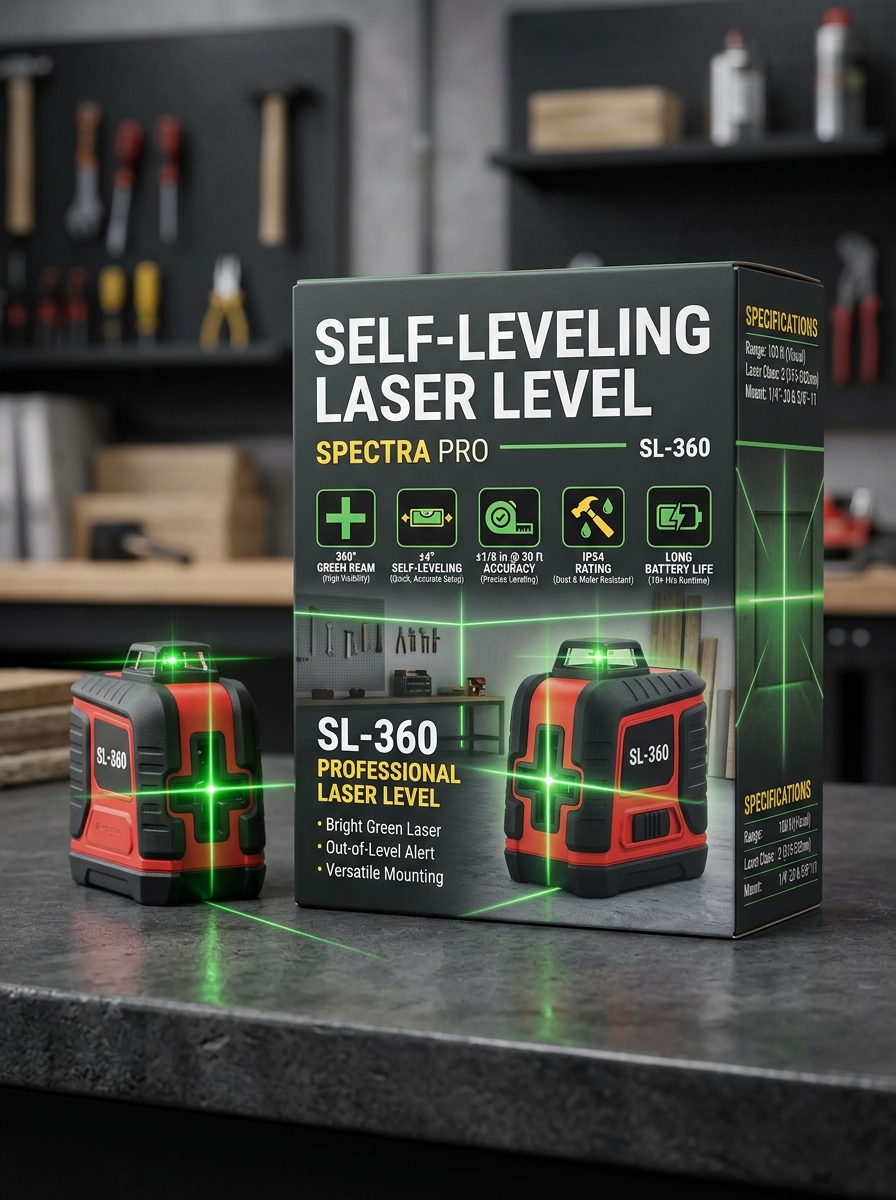
Typography and Iconography for Rapid Technical Communication
Self-leveling laser levels utilize specialized typography and iconography to ensure immediate data interpretation on busy jobsites. High-contrast, sans-serif fonts are standard on control panels and digital displays to maintain legibility under harsh lighting or dusty conditions.
The iconography employs universal symbols to communicate critical tool status rapidly:
- Pendulum Status: Visual locks/unlocks indicate if the compensator is engaged.
- Out-of-Level Warning: Flashing icons or LEDs alert the user when the unit exceeds its leveling range.
- Power Management: Intuitive battery bars provide real-time energy monitoring.
This standardized visual language minimizes cognitive load, allowing professionals to verify accuracy and switch modes-such as pulse mode for receivers-without pausing to consult a manual, thereby enhancing operational safety and precision.
Sustainable Material Selection in Modern Tool Packaging
Modern self-leveling laser levels are increasingly shipped in eco-conscious packaging designed to minimize environmental impact while ensuring instrument safety. Manufacturers are moving away from expanded polystyrene (EPS) and single-use plastics, opting instead for FSC-certified recycled cardboard and biodegradable molded pulp inserts.
These sustainable materials offer excellent shock absorption, which is critical for protecting the sensitive internal pendulums and optical components of a laser level during transit. Furthermore, the use of soy-based inks and water-based adhesives makes the packaging fully recyclable or compostable. By prioritizing sustainable material selection, tool brands align with green building initiatives and reduce job site waste. This evolution in packaging demonstrates that high-precision professional tools can be delivered responsibly without compromising the durability or calibration of the device.
Optimizing the Professional Unboxing and Storage Experience
For a high-precision self-leveling laser level, the professional experience begins with secure, well-organized unboxing. Investing in premium gear requires a hard-shell carrying case designed with custom-molded foam inserts to safeguard sensitive internal components, such as the pendulum mechanism, from impact during transport.
Efficient storage solutions optimize workflow by ensuring that essential accessories-including lithium-ion batteries, magnetic mounting brackets, and target plates-are easily accessible and protected from job site debris. A robust storage system also maintains calibration accuracy by preventing unnecessary vibration. For contractors, a professional-grade case is a vital safeguard that extends the tool's lifespan and ensures reliable precision. Prioritizing organized storage minimizes downtime and reflects the professional standards required in modern construction and alignment tasks.
Leveraging Transparent Elements for Visual Product Verification
High-quality self-leveling laser levels incorporate specialized transparent elements to facilitate immediate visual verification of internal components. These high-clarity windows are essential for maintaining tool accuracy and operational integrity in demanding construction environments.
- Pendulum Inspection: Transparent housing allows users to confirm the internal pendulum mechanism is unobstructed, ensuring the gravitational self-leveling feature functions correctly.
- Optical Clarity: Clear apertures enable the inspection of laser diodes for dust or moisture that might diffuse the beam or affect the precision of the horizontal and vertical lines.
- Structural Verification: Visible internal assemblies allow professionals to verify the build quality and alignment of the laser modules without dismantling the device.
By utilizing these transparent features, operators can perform quick diagnostic checks, ensuring their laser level remains calibrated and reliable for precision layout tasks.
Communicating Accuracy and Range through Minimalist Graphics
For a self leveling laser level, minimalist graphics are essential for translating complex technical data into actionable insights. By utilizing clean icons and streamlined diagrams, manufacturers communicate critical accuracy specifications-such as precision rates of ±1/8 inch at 30 feet-without overwhelming the user.
These visual indicators focus on two primary metrics:
- Precision Tolerance: Minimalist +/- symbols quickly denote the deviation margin, ensuring reliable leveling.
- Working Range: Simple geometric radii or distance markers illustrate the maximum effective beam reach and visibility.
By removing visual clutter, these graphics allow contractors to instantly verify tool capabilities. This semantic clarity ensures that laser line projection and range limits are understood at a glance, reducing setup errors and enhancing jobsite efficiency through intuitive design.
Maximizing Shelf Impact in Competitive Retail Environments
In the crowded hardware market, a self-leveling laser level must command attention through strategic visual merchandising and clear value propositions. To maximize shelf impact, manufacturers should prioritize packaging that highlights automatic calibration features and high-visibility beam technology.
Key strategies for retail differentiation include:
- Feature Callouts: Use bold icons to signal dust resistance (IP54), accuracy tolerances, and battery life.
- Visual Contrast: Display high-resolution imagery of the cross-line laser in real-world applications like cabinetry or tiling.
- Interactive Elements: Incorporate "Try Me" displays that allow users to witness the leveling pendulum in action.
By emphasizing precision and ease of use through premium, informative packaging, brands can effectively convert professional contractors and DIY enthusiasts looking for high-performance layout tools in a high-traffic retail setting.
Future Trends in Interactive and Digitally Integrated Packaging
The packaging for self-leveling laser levels is evolving from simple protection into a sophisticated digital touchpoint. Future trends highlight interactive packaging solutions, such as QR codes and NFC tags, which offer instant access to calibration tutorials, virtual user manuals, and safety certifications.
Augmented Reality (AR) is becoming a cornerstone of tool packaging, allowing professionals to visualize a laser's fan angle and accuracy through their smartphone before even unboxing the device. This digital integration ensures that users understand complex features like pulse mode or manual slope locking immediately.
Additionally, smart packaging enhances supply chain transparency. Embedded sensors can now track if a precision leveling tool has been dropped or exposed to extreme temperatures, ensuring the internal pendulum remains factory-calibrated for the end user.
Leave a comment